
30 Days, 900 Very Ripe Bananas
You might remember a guest post about fruitarianism on No Meat Athlete last year that drew a lot of negative comments, mostly dismissing the diet as a fad. But Ben Benulis wanted to see if there was something more to it. Here he is with a post about his experiment.
As vegetarians and vegans, most of us are comfortable going against the grain. We buck the trend of the standard diet in favor of something we feel is better.
But even the most open-minded of vegetarian and vegan individuals will eventually draw the line somewhere.
Case in point: Fruitarianism.
Controversial things like this pique my curiosity. When I read last year’s No Meat Athlete post on the fruitarian diet, I began to ask questions:
- How could anyone survive, even thrive, on just fruits and vegetables?
- Why were people so quick to jump to conclusions that this diet was unhealthy/nutrient-deficient/unsustainable/expensive/ridiculous?
- Why was there such a negative backlash on something that, to me, sounded kinda cool?
- If fruits and vegetables are the healthiest foods, is it really so crazy to eat them to the exclusion of everything else?
If you look at the comments of the NMA post on fruitarianism, a lot of people seemed to magically become experts on why this was bad, without ever having read anything else on the topic or, better yet, trying it themselves.
I had the opposite reaction — someone going so ridiculously against the grain intrigued me. With such negative backlash, I wondered what the big deal was. I had to investigate for myself.
A rose by any other name
It turns out what many of us call “fruitarianism” is actually the 80/10/10 diet, designed by Dr. Douglas Graham. Dr. Graham is a lifelong athlete, a raw vegan since the 1980s and hasn’t had a sick day since before I was born. (I’m almost 30.) For me, that’s enough for me to wonder if he might have stumbled on to a secret or two in his lifetime.
His book, The 80/10/10 Diet, is an excellent, interesting read. It’s the culmination of years of experience and research that produced a few other books as well, including Grain Damage and Nutrition and Athletic Performance.
Before anyone undergoes such an endeavor (or dismisses it outright), I’d suggest picking up this text. If you’re looking for the Cliff’s Notes version, here are some of the highlights of the 80/10/10 diet:
- Eat plant-based whole foods in their natural state. Nature provides food to us, as is, with everything we need. If we cook something, we alter it and it is no longer a whole food. No other animal in nature cooks their food. (You don’t see monkeys in the rainforest sautéing their greens, right?)
- When calories from protein exceed 10% it leads to poor health. Protein from raw plants is best. Cooked protein from any source is denatured. Animal protein is especially toxic.
- When calories from fat exceed 10% it is excessive. Cooked fats in particular are carcinogenic. Oil is not a whole food and should be avoided.
- Carbohydrates are then left to be at least 80% from calories as a lower limit. For carbohydrates, fruit is king. It tastes great, comes in its own packaging, and doesn’t need to be cooked or altered in any way.
- Grains are indigestible in their raw state. Since one has to cook them, they are not a whole food. Grains have a poor micronutrient content (relative to fruits and vegetables) and various “anti-nutrients,” such as gluten.
Putting theory into practice
I’d advise a gradual transition to the diet. I experimented with his recipes and slowly started incorporating more and more fresh fruits and vegetables in my diet until they were about 80% of daily intake. Once I felt comfortable with this, I decided to try a 30-day trial of this diet, full blast, 100%.
Fundamentally, the 80/10/10 Diet involves getting your primary calorie source (94-98%) from fruit. Your main source of macronutrients (calories, carbs, protein & fat) is fruit and your main source of micronutrients (vitamins and minerals) is vegetables.
However, since fruits are far more calorically dense than vegetables, you end up eating equal volumes of fruits and vegetables. Here is what a typical day looked like for me:
- Breakfast: 1-2L of water. 3 large mangoes (600 calories)
- Lunch/snacks: 4L of strawberry-banana smoothie. About 27 bananas and 1/2 lb of strawberries with simply water as a base. (2,900 calories)
- Dinner: Large spinach salad with tomato and 1/2 an avocado and homemade blueberry/date dressing (250 calories)
That brought my total calorie count for the day to 3,750. For an active person like me, at 6’1″ and 170 lbs, this was about right. On very active days, I ramped up my calorie count.
In all, I was able to cover all my macro and micronutrient needs, aside from Vitamin D and Vitamin B12, which aren’t usually in plant foods, anyway. I feel pretty darn good about that.
The good, the bad, and the ugly
Who has 27 ripe bananas in their house for one day of eating? It can be a bit challenging. To make it work, I discovered a few key strategies:
Inventory management:
I’d like to think my work background in supply chain management helped here. Not only did I need to have enough fruit, I needed to have enough RIPE fruit. When you buy fruit from the grocery store, it usually isn’t ripe yet — there is a window of ripeness between underripe and overripe that must be carefully managed.
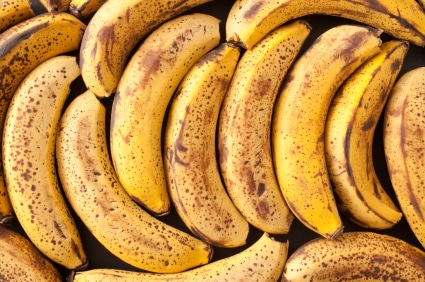
There’s a highly technical way to determine ripeness, and I’ll let you in on the complicated secret: A banana must be brown and speckled, like a “dinosaur weiner.” (If anyone asks you where you got such privileged information, don’t tell them I let you in on the secret!)
I needed lots of speckled dinosaur wieners. So I bought in bulk. I found out that if you buy an entire 40lb box of bananas from the grocery store, they give you a 10% discount. $17 for 40lbs of bananas is 3 days worth of food. Turns out this diet is pretty cheap after all!!
Of course there were the awkward questions at the checkout line. I got tired of people not believing me when I said I was going to eat them all so I started telling people I had a pet monkey.
Whenever a certain type of fruit was on sale, I bought as much as I could carry. On one weekend drive out to the country my wife and I passed a farm fruit stand got a 40lb box of peaches for $18. For 3 days, I ate pretty much only farm-fresh organic peaches and spinach. Despite what you may think, it was fantastic.
A blender is essential:
30 bananas a day is best accomplished by drinking most of them. There end up being endless permutations of possible smoothies. For the sake of easy digestion, smoothies of more than 3 ingredients are discouraged. If you’re on the 80/10/10 diet, your new motto is “simplicity at meal time, variety throughout the year.”
Social situations:
The diet makes it challenging (not impossible) to meet friends for dinner. If people asked, I just told them I had eaten before I got there (which was often true). Your main option at any restaurant is a salad with no dressing.
Taste buds:
The longer you do this diet, the more your taste buds “wake up,” and you no longer need dressing on a salad because the vegetables taste so good on their own.
My taste buds became “re-sensitized”. Fruits and vegetables just tasted better and had more flavor. Lettuce and spinach, just on their own, tasted delicious. Conversely, veggies like jalapenos, olives and banana peppers (which I always loved) had almost too much flavor and became hard to eat.
Cravings for things outside the diet:
This was tricky. There were times when cravings for a burrito or tofu stir-fry crept in. To manage this, I ate enough fruit during the day so that I would always be satisfied. I counted my calories to make sure I was getting enough to sustain me through the day. Once I mastered that, the cravings never really hit me anymore.
The results
While undertaking this experiement, I noted a few changes in my body. I lost 5 pounds of body fat, going from 11% body fat to 8%, though I was eating as much as I wanted (anywhere from 3,600 to 4,400 calories a day).
I also noticed insane athletic recovery. I’m no Ironman triathlete, but I do like to get out there and hit it hard when I can. I had one day where I did 22 miles commuting on my bike, a superslow strength training workout at lunch, and 2 hours of footbag at night. The next morning I woke up fresh as a daisy not an ounce of soreness.
I slept better. I felt clear-headed. I was more productive at work.
I just felt better.
Lasting impact?
I was a “fruitarian” for 31 days — 1 day longer than planned. On the 32nd day, I broke down and had some Chinese stir-fry. After I ate it, I felt like someone had force-fed me 10 sleeping pills and then punched me in the stomach.
I took a week off and truthfully went on what turned out to be quite the vegan junk food bender. I had an obligatory monster burrito and even an entire Whole Foods vegan pizza in one sitting.
At the end of the week, I went out for a run and woke up the next day, sore for the first time in over a month. That was the signal to re-embrace the diet.
This time, I’m going for 60 days.
Ben Benulis is a vegan footbagger and runner who also enjoys cycling and strength training. He lives in Austin, TX with his wife and 2 dogs. He blogs at Vegan Gym Rat and is sometimes hangs out on Twitter as @ironcladben.
PS — For any NMA readers in the Madison, WI area this morning (Friday, Sept. 9, 2011 ), for Ironman Wisconsin or anything else, NMA writer Susan Lacke is hosting a little meetup at 10 AM at the coffee shop on Main and Martin Luther King in Madison, by the Ironman Registration. Come hang out!
Leave a Reply
This is a great post. I am like Ben in that I can’t believe how many experts there are. I get the questions about protein as a vegetarian all the time and when they say meat I tell them about the protein in all the vegetables and their comment: I had no clue.
Just like this diet I had no clue you get that many calories but I would never just dismiss it as if it were impossible to live on.
I think it all depends on your own body and what you can handle. Of course if we ate all organic then we wouldn’t have the food allergies that we see b/c I believe they are brought on my pesticides.
Hi Ben. Glad to hear that you had such a positive experience. I’ve been playing around with 80/10/10 for a couple of years now and love it. I don’t always stick to it 100% but always find my way back after a day or 2. In fact, I have tried to quit it but it seems my body is just naturally drawn to it now.
All the best for the next 60 days 🙂
-
I hv plan to kep on 10 bananas a day…. Is it enough for me to do it
Woah, wow. Thirty bananas a day?! I’m impressed, intrigued, and maybe just a little bit … I don’t know, amazed, I guess? Glad it sounds like it was a successful experiment, because eating thirty bananas a day for nothing would be a major bummer.
Poor Ben must have been crazy mosquito bait this summer!
I always feel better when I eat raw. But it is so hard to sustain with a family. However, it sounds like you had a great and extremely successful experiment!
not for me, but totally interesting to read! I’ll be curious to hear updates and see how long you stick with it. Was this post by Matt or someone else?
Awesome post, Ben. I find this stuff fascinating. Wasn’t it you who told me that Michael Arnstein (the Fruitarian) won the Vermont 100-miler? Is he 80/10/10 or more pure fruitarian?
-
arnstein did indeed win it . . . but i don’t think he was eating raw or even vegan during the race (someone correct me if i’m wrong on this). it can be really tough to eat 811 during events like that though, especially if you’re unsupported. he’s an amazing athlete though and has put a lot of his own time and money into spreading the word about 811.
-
He was only eating fruit. 🙂
-
hmm. i’m pretty sure he mentioned in his race report on 30bad that he ate caffeinated gels, pb&j sammies, etc.
just to be clear, i’m not judging him! i’m very much the same way- i deviate from 811 during some endurance events because fruit just isn’t palatable after a certain point and you need to get those calories in somehow.-
Oh sorry. You may well be correct then. I must of missed that post. I could always just ask him I guess. Cheers 🙂
-
-
-
-
michael arnsein is 80/10/10….because he incorporates leafy greens in his diet.
alot of fruitarians like anne osbourne, do not eat greens
Wow, really interesting. I’m a long-time vegetarian, turned vegan early this year. Admittedly, I have been one of those who scoffed at a “fruitarian” diet, though in general I respect the idea of a raw vegan diet. I live with an omnivore, so there is only so much “craziness” he will tolerate – though he went vegan with me for about 6 months and lost more weight and admitted he felt better. Anyway, thanks for the eye-opening post, I think I will take a look at Graham’s book. I’m training for my first marathon, and I could use all the help I can get! I don’t think I could do it if raw cacao is discouraged though…that would be too depressing. 😉
-
Hi Joy, hope you enjoy the book. Raw Cacao is discouraged mainly because it’s an addictive stimulant. Anyways, the whole point of the post is that it’s a 30 day experiment. You can go back to your cacao after your trial run is over 🙂
Had I read this 6 months ago I would have thought it was crazy, but I’m learning that what we are taught is correct for nutrition is not necessarily true. I completely agree with the idea of trying it and seeing how your body feels/reacts. The 80/10/10 split seems to be more in-line with what I’ve been learning eating a plant-focused diet – you don’t need as much protein as you think. I’d love to hear another update after the 60 day experiment – I’ll be curious to see how you feel and if you are longing for different tastes or still enjoying it.
Bananas are my favorite food, and I’ve often had 3 in one day. But your diet may seem a bit excessive – bananas are loaded with potassium, as you know, and too much potassium can stop your heart! You are lucky you had a good outcome but please do not recommend this diet to everyone! It’s not safe for those with kidney or heart problems (though I doubt anyone with heart problems will be doing any marathons).
-
Hi Lisa, it’s a misconception that you can get potassium poisoning from too many bananas. Potassium is a water soluble mineral and your body can easily excrete excess from your food. The only way to get potassium poisoning would be by ingesting actual chemical potassium isolate on its own in large quantities. The guy who runs 30 bananas a day has eaten 72 in a day before and thousands in his life, never had an issue with it!
-
Well, Ben, I would sure like to know why my husband was admitted to the hospital for a ‘false heart attack’ when he consumed 5 bananas in one day then. He loves them! LOL No, I mean…. LOVES THEM! He eats bananas like other people eat candy or chew gum. One day we were out running around and ‘playing’ on the beach and he started having pains. Major pains in his chest and down his arm. Cold sweats and feeling dizzy. We decided to go to the hospital just to check him out and make sure everything was ok. When they checked him, they asked what he had been eating because at the time, he was on no meds and didn’t even take a vitamin or any other supplement. He’d had bananas… at breakfast, lunch, snack, AND dinner! His potassium levels were through the roof! As a result, he has been on banana restriction since then. And luckily, we’ve never had the issue again. So while for the vast majority of people it probably is a non-issue, there ARE people who can have problems with it. But you know, that’s how it is with any diet/lifestyle — you just gotta find what works best for you and your body. 🙂
-
You are full of crap. You’re probably some Paleo nutjob trying to scare people away.
-
I agree, that was a fabricated story.
-
-
If his potassium levels are through the roof, this is a kidney issue not a diet issue. Your kidneys are responsible for maintaining sodium/potassium balances in the blood stream so if it is out of balance, it is because the kidneys aren’t doing their job.
There’s your explanation.-
Previous comment is correct. There is an issue with the kidneys being unable to filter/excrete properly.
-
-
The symptoms you describe are those of a heart attack. They are completely different to the symptoms of excess potassium. A far more likely explanation for elevated potassium levels is kidney disease rather than banana intake.
A medium banana contains about 400mg of potassium . It takes around 18,000mg of potassium to cause hyperkalemia. in a healthy person. You would need to eat nearly 50 bananas to reach that level. In practice your body will excrete potassium far faster than you can eat bananas.-
Overdose maybe not but for i, i’ve notice when a take lot of banana and melon and dont have enough sodium i’ve make water retention like on a sodium overconsumption… 🙁
I try to resolve that with celery,cumcumber,beet juice since today…. -
Ahahha, you guys crack me up. Hey drinking alcohol then is a liver problem , also taking cocaine is a liver problem. The problem you put not needed pressure on your kidneys that is the problem. Eating mono meals high in anything will put pressure on eliminating organs and it is not their problem, it is your food choice problem. LMAO
-
-
There are over 1000 different foods with more potassium than a banana.
-
-
-
LISA,
this potassium overdose is a HUGE misconception – If you did some proper research you would find that in order to have a potassium overdose from too much fruit or bananas, you would have to eat 300 bananas in about 1 minute…..this is obviously impossible…….the 80/10/10 is a perfectly safe diet for those with kidney and heart problems……especially good for the kidneys because of the lack of stimulants, caffeine, etc and NO EXCESS SALT…….
Very interesting article Ben, thanks for “testing out” the 80/10/10 theory. Heck , people think I’m crazy for eating 5-6 bananas a day!! One question; are there no side effects of too much potassium? Actually two questions (sry); did you or do you recommend taking any supplements to compensate for the essential vitamins this diet is lacking?
-
Hi Jay, I just left a comment above about the potassium thing. Essentially the only way to get “too much” potassium is to ingest a chemical isolate.
The diet is by no means nutrient-deficient. Fruits and vegetables meet our nutrition needs moreso than any other foods. Go ahead and plug in the foods above into cronometer.com and you’ll see it’s nutrient-rich.
Just like a standard vegan diet, the only nutrients not derived from food are Vitamins B12 and D. B12 can be supplemented (or some argue, created by bacteria in your gut) and D can be gotten the natural way, through 15 minutes of sunshine each day.
This is really interesting. Thanks for the post. I can relate to enjoying salads without dressing. Raw spinach and lettuces are so flavorful, I can’t believe I spent years drowning out their taste with salad dressings. I’m intrigued to learn more about the 80/10/10 diet, but not sure about giving up my beloved oatmeal. 🙂
-
With you on the oatmeal, Elizabeth.
I also read Dr. Graham’s books and gave the diet a good 60 days. But keeping ripe fruit around was so much of a challenge, that some times I was puking from all the green bananas I was eating. I run a lot of miles 50-70 per week and I my body finally went into an anemic state of no return as of yet. Although I did enjoy the short euphoric high level of recovery and clarity for a brief time. I suggest reading In Defense of Food: An Eater’s Manifesto by Michael Pollan to get a a fair shake on food and nutrition.
-
The problems is that you were eating UNRIPE bananas. They contain a lot of resistant starch and can cause major gut upsets.
-
Yep, gotta eat RIPE fruit only just as we were meant to eat it.
-
MaD R-E-S-P-E-C-T MaN!!!! I would LoVe to think that I could master this endeavor for 30 days, but I’m still struggling with complete veganism…so this will have to be put on the “to do” list 😉 What about your wife though? Did she do it too? And how supportive/helpful was she in the process???
-
It helps a lot that’s she vegan too. She was very supportive. She ate a lot of banana smoothies, and still does. She even brought home my favorite chinese food one day and hid it from me so I wouldn’t smell it.
-
I did, however, not enjoy the smell of ripening fruit throughout the house and fruit flies invading our kitchen 🙂
-
ha ha!!! I can only ImAgInE :/
-
-
Unless you live in a tropical region, eating bananas is very detrimental to the environment because they are so heavy and bulky, it takes a lot of energy for transportation costs. Also, they are not so benign when it comes to pesticides (see https://www.treehugger.com/files/2007/08/pesticide_lawsuit.php). We always buy organic bananas because it’s better for the farmers and the wildlife that are sometimes collateral damage from the pesticides used on bananas. So, my family has cut back on the amount of bananas we consume. I personally used to have 2 or 3 day. Now its about 1 or 2 a week. I just use them sparingly as an egg substitute. After watching the documentary “Fat, Sick and Amost Dead”, I did try a diet similar to what the subject of the movie tried. It was mostly a juice diet but I also added legumes, quinoa and nuts and berries. I do have to say, I have never felt better both physically and mentally. After about 3 days on it, I had a nagging knee pain that had been bothering me for months, it completely dissappeared. It was incredible. The hardest part was giving up my usual vegan pancake breakfast for a vegetable juice I had every morning. But after a few days, I got used to it. I was on it for about 4 weeks. So, now I try my best to restrict grains especially gluten grains. I do eat quite a bit of quinoa which is technically a seed not a grain and is a good source of protein.
-
Hi AK, I’m going to have to disagree with you. Eating bananas and other fruit actually promotes forestation, while most other food promotes de-forestation. Trees are the lungs of the planet. Yes there is an energy cost to transport food, but almost anything you eat has that unless you grow it in your garden.
-
ah, crops don’t really count as ‘forestation’. Forestation has to have a level of biodiversity for it to be useful. That’s basically also suggesting that palm plantations are fantastic too… if you are ripping up the native vegetation to put in crops (of any kind) it is generally a bad thing.
also, yes all food has transportation and energy costs but my box of organic veg travels less than 100km to get to me, if I want to eat 30 bananas a day they have to travel over 2000km to get to me.-
When eating 80/10/10, it’s best to always keep a high-calorie fruit on hand, like bananas, as your staple. If you don’t want to eat bananas because of the environmental reasons, you can rely on mangoes or dates, for example, which you would likely be able to find grown even more locally than your vegetables. Many people on 80/10/10 only eat local and organic.
By the way, I’d like to add that I avoid grains like quinoa because humans can get all the protein they need from fruits and veggies. Quinoa has no other nutriets, and grains in general will overwork and enlarge your pancreas if eaten to much. They are highly acidic and will lead to constipation (which I’ve read is one of the biggest factors in causing cancer since your digestive tract is always making new cells. Personally, wouldn’t want to take that chance).-
Dates are a tropical fruit as are mangoes… just like bananas. I don’t live in the tropics, they aint available ‘more locally than my veg’.
Can anyone link me a peer reviewed article that supports this sort of diet? I don’t want to sound aggressive but I would really like to know what the nutrition and dietetics academic community think.
Honestly eat what you like but I really get sick of people saying things about food without a shred of evidence to back it up. If all the food that apparently give you cancer, actually gave you cancer, 95% of the population would have cancer. -
better to peel a banana then shove a steak down your throat
-
-
Steph, sorry, no peer-reviewed journals on this. The medical industry doesn’t pay much attention to any health advice if there’s no money to be made from selling you drugs, cutting you or burning you. If peer-reviewed medical journals are the only source of information you will listen to, then this is probably not for you. There is only self-reported and self-evident results of people who have tried the diet, which are overwhelmingly positive.
-
-
-
If it required a lot of energy to transport bananas they would be expensive. The fact that bananas are very cheap proves that little energy is used to transport them. Bananas require far less handling than any other fruit. They are harvested as a single bunch, trucked to the port and shipped in bulk.
The energy you use driving the bananas home from the market is far greater than it takes to send those bananas thousands of kilometres by ship and truck-
Sorry, that is patently untrue. Shipping any food via container is extremely expensive. Bananas costs are minimized by the amount shipped but are not cheap everywhere. When I buy just 3 or 4 Bananas in Indiana a achain like whole fods, those 3 organic Bananas will cost almost 6.00. Prices are relative.
-
very interesting read-thanks for sharing your experience Ben 🙂
Pet monkey, heh.
And I thought I get funny looks when I frequently buy 3-5 bags of bruised bananas at the grocery store…
This sounds like a crazy idea, but a good one. Might have to give it a whirl sometime.
-
Yes, eventually you just get used to being asked and don’t sweat it any more. Give me a shout if you ever have questions.
I’ve read that some fruitarians experience demineralization of their teeth as well as other dental problems caused by the high sugar content of the fruit. Other than that, it seems like an interesting diet, but I’m not sure I could stick to it through a cold Canadian winter.
-
Hi Nicky, any demineralization may have been caused by not eating enough vegetables. “Strict” fruitarians who neglect vegetables have this problem. Vegetables are a key part of 80/10/10.
Regular fruit is high in fiber and won’t stick to your teeth. But if you are eating a lot of dried fruit, especially raisins and dates, that can cause dental issues.-
It also has to be noted that no everyone practices good dental hygiene, regardless of their diet. Rinsing your mouth, lightly brushing with toothpaste and flossing.
-
I should probably mention that for the past 10 months dates have made up the bulk of my daily calorie intake and I have no dental or weight issues.
-
I’ve been on a fruitarian diet for the past five months, and I’ve eaten dates on a regular basis.I don’t have any dental problems.I feel like my teeth have actually gotten stronger. Flossing and a little brushing with xylitol toothpaste with no fluoride probably helps.
-
-
-
-
The sugar in fruit is mostly locked inside the cells. Only a tiny amount of sugar is released when you eat the fruit. Most of the sugar is very slowly released in the gut. Your saliva quickly washes any sugar off the teeth. [In fact cooked starch such as bread is far more likely to cause tooth decay than sugars.]
Chimpanzees have zero tooth decay despite eating huge amounts of fruit and never brushing or flossing.-
Please show me your source(s) for “Chimpanzees have zero tooth decay”. Next time I visit the dentist and they give me “the talk” about my fruit diet, I would like to throw some science at them.
-
Very interesting indeed.
I love bananas and eat about 3 a day as it is. I do a lot of raw and don’t add oils at home. I DO love nuts/seeds though and don’t think I’d be happy without my bit of raw, homemade almond butter.
Just want to mention, bananas are one of those terribly unethical, bad for the environment crops unless you’re buying fairly traded ones. Even organic, if it’s Dole or Chiquita or something like that, aren’t really great. Human rights infringements run rampant.
The only bananas I’ll buy are the Earth University ones at Whole Foods, since Earth is ethical and environmentally sustainable. I’m all for doing a healthy diet but buying so many slave labor or environmentally destructive bananas rubs me wrong.
If you’re buying Earth ones, kudos! If not, take a look into the issues and see if you can find Earth bananas or something similar, if what is going on bugs you, too. As vegans, there are always so many things we need to look at with our food to make sure we’re not hurting animals – human or non-human. 🙂
-
Great point, Melissa. Thank you for sharing!
And Ben, thanks so much for the post, it was a great read!
-Lisa -
Hi Melissa, do you have a link to share?
-
Some of us don’t give a crap about humans. People are the reason the earth is a shithole.
-
If you’re considering suicide, please seek help.
-
If you don’t give a crap about humans, you can never be a vegan. Humans are animals too.
-
Awesome post Ben! What timing too! I’ve been curiously reading blogs and watching Youtube vids (including yours) the last week or so regarding the 80/10/10 diet and even started the first 2 chapters of the book the other day. Very interesting so far. I’m intrigued to say the least. I’ve been vegetarian for 2.5 years and vegan for almost 2 and I’m ready to start dialing in my diet for fitness with a focus on raw foods–I started running last year and will be starting a boot camp in the next month or two.
My one concern so far (and maybe this will be addressed in the upcoming chapters of the 811 book) is sourcing all of the bulk ingredients and at a cost that is sustainable. I only buy organic fruits/vegetables so I anticipate this could be a very costly diet, especially when I see so many people importing all kinds of exotic fruits. Was the 40lb box of bananas organic?
Good luck with your next 60 days!
Also, thanks to Matt for letting you share your story on here!
-
Hi Josh. Glad to hear you are excited.
Organic bananas are usually around $32/box ($.89/lb) . So a little bit more expensive. I got them when they were available, but I would say half the time I had to get conventional because that’s all the store had.
I’m an a-tarian: I only eat foods whose name contains the letter “A”. Apples, strawberries, soja, squash, cool with me. Peppers, olives, broccoli, lettuce, never touch that stuff.
Hey, don’t look at me like that. It’s not any sillier than refusing to eat half of the veggie foods for no good reason. I’ll become a fruitarian when someone gives me a good reason why I shouldn’t eat as many or more non-fruit veggies than I eat fruits.
-
Refusing is different than choosing, and sharing results of an experience is different than telling you what to eat or not eat 🙂
I think the reasons for choosing this kind of diet were made pretty clear. Not that you must agree, just throwing it out there.
@ Meister – yeah you would think that mosquitos would be bothersome. I usually go up to my home state – Montana, every summer and every year I’m always attracting mosquitos. Not this summer, why? Because I’ve been on the Fruitarian lifestyle and it was surprising that I wasn’t bothered by mosquitos. Which was REALLY nice and it was nice to not have to bring out the mosquito spray as that really stinks and chemicals being on me – DISLIKE! 😉 So it was an awesome change this summer to enjoy the outdoors, not being bothered, and not wearing chemicals!
And yes, I notice MAJOR changes when I eat other foods that are not 811 (shortened version of 80/10/10)- I feel crappy, my asthma comes roaring back, and I feel “plugged / stopped up” overall. My energy tanks. So 811 is a great lifestyle and yes, there’s lots of trial and errors to figure out what works for you. For me, it’s more of an issue to eat that much of fruits because I’ve never eaten fruits before (I was a junk-food & meat / potatoes addict) and I’m in my mid-30’s and I know it’s also a mental thing too (at least it’s for me) so this is all still in progress / transition for me but I’m happy to say that I’m FINALLY meat-less. 😉
I am very stoked for you and your 30 day experiment with being a fruitarian. I would actually like to try it myself. Where I am confused, though, is how did you incorporate all of your essential proteins into the diet? Do not get me wrong, I will choose a giant colorful salad over a steak anyday, but my fear of going completely vegetarian is not getting enough protein. I like to stick to keeping everything in moderation with the right balance of carbs, protein, and fat. I am what books call a Flexotarian.. I do not eat red meat and I am flexible with my overall meat intake. When I do eat meat it is poultry, fish, and eggs.
-
Hi Dara, it is a myth that a vegetarian or vegan diet does not have enough protein. Have you ever met anyone who has a protein deficiency? It’s a myth.
My suggestion to you would be to read up on it with books like the China Study, Thrive and 80/10/10 and learn about plant based nutrition and find out for yourself.-
I have never met a person with a protein deficiency but I have studied it.
Here is a link: https://www.ncbi.nlm.nih.gov/pubmedhealth/PMH0002571/
Now please, do get me wrong by thinking that I am some anti-vegetarian/vegan because I am posting this. I actually went through a period of vegetarianism at one time.
What I am simply stating is a diet must be balanced in order for your health to be balanced. This does not necessarily mean eating meat… beans and rice are a great substitute for animal. So is peanut butter and jelly.
While practicing fruitarianism would be exciting, I could not see myself doing it for the rest of my life BECAUSE of the lack of protein.-
Dara, you posted a link but have you ever heard of anyone having this condition? It only happens in 3rd world countries. Kwashiorkor occurs almost exclusively when there is a lack of calories in the diet, i.e. starvation. It is impossible to not get enough protein from eating fruits and vegetables.
-
Ben,
I want you to know that I did not post the link to that website to show that kwashiorkor is common in vegetarians, just simply that there is such a condition cuased by a protein deficiency. HOWEVER, I also want you to know that cutting animal based products out of my diet has been an exciting thought yet a fearful one due to the way I have been raised and what I have been taught (especially being a Texan).
I just watched the documentary Forks over Knives and I have decided that I am going to practice a plant-based diet and see where my body goes. From what I have observed, it is only going to head towards better health.
You must understand though, that this constant pull between eating animal products and not has been due to documentaries like this leaning toward plants and professors/doctors/books telling me how important it is to eat a well balanced diet that includes animal products.
That vegetarian period I went through was a total of two weeks. I loved it. But I also loved fish and venison.
I am going to keep up with this one now. I am excited to see what kind of changes I will go through, good, bad, or both.
Thank you for posting this article. -
-
-
-
great read! i have found that i recover much faster after running just since starting my vegan diet. i’d love to give this a try just to see the results!